



What does spread mean in betting

Since launching in 2014, Tribuna.com has grown from a sports news website into one of Europe's largest digital sports media platforms, producing over 2,000 pieces of content daily in nine languages and managing several popular mobile apps.
COVID-19 and the war in Ukraine forced Tribuna to adapt.
Facing the limits of traditional sports media revenue, the platform attracting ten million monthly visits, evolved into a multi-layered business combining advertising, affiliate marketing, and paid subscriptions.
MightyTips spoke to Tribuna.com CEO Maksim Berazinski about learning affiliate marketing from scratch, building a data-driven media product, scaling multilingual content with AI, and why modern sports media must reinvent both content and business models to compete globally.
Maksim Berazinski: We still work with the advertising model, but it's not enough to make unit economics work. We didn't just add the affiliate part; we also added paid subscriptions to our app. Now, with three business models, each of which is essentially a separate type of business, we're trying to sustain everything we have. We're a big project with a big team – over 250 people.
We have big ambitions regarding which markets we want to enter and what we want to achieve. To run all these experiments, we need resources. With just the advertising model, we couldn't afford that. We'd be thinking about cuts, layoffs, downsizing, shrinking – not about growth.
So now, with these three models, we're looking into the future much more confidently. We have aggressive plans for how we want to develop apps and our sports media. Because we haven't taken off the agenda the task of making something great, reinventing media essentially.
We're a bit about madness and courage, perhaps. When the big war [in Ukraine] started, we consciously didn't go the route of "let's cut something to make ends meet." On the contrary, we hired more people and went all-in for foreign tier one media markets. This remains a challenge for us.
Besides the affiliate model, we're aggressively looking towards paid subscriptions. There are 140 million Barcelona fans in the world, on Barca's social media. And we'll be able to quickly show them our app once our unit economics are figured out.
Basically, we have this complex structure where media can't earn anymore just as plain media – it must think about something else too. This allows us right now to be next-generation media, which includes business processes as well that we didn't have to deal with before.
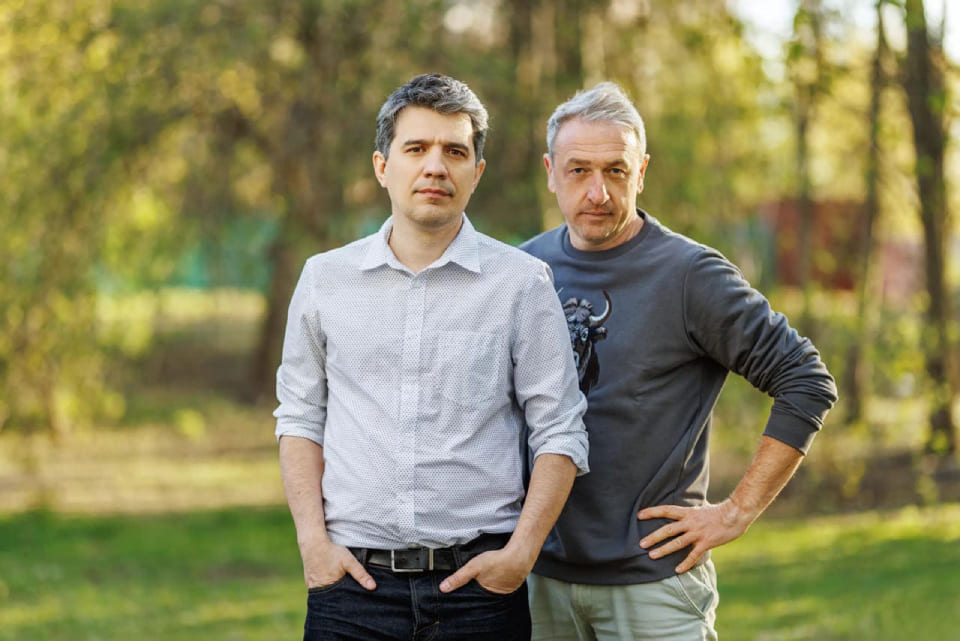
Maksim Berazinski (L), Tribuna.com CEO, and Dmitri Navosha, Tribuna.com founder
Maksim Berazinski: It's something we had to learn from scratch. Me, our Head of Sales, and our other guys who haven't dealt with this before. Simply because it's a slightly different type of business.
We did work with bookmakers before the big war, one way or another. But it's one thing when they come to you with a marketing budget and buy branding from you, some banners, and other inventory.
We didn't really know what was happening on the other side. We just sold our inventory – it converted somehow, I suppose. Given they were coming back to renew contracts, it converted pretty well, probably. But we didn't dig any deeper. We didn't know from which page the lead came, we didn't know what their LTV was, we didn't know how many high rollers we had.
We didn't even try to find out. We stopped our interaction at the level of "let's agree on a media budget for next year, quarter, or month."
And when we dived into this, we essentially got to know our product better. We learned which places convert better. We understand that we're not efficient with sports traffic, and we have a lot of it. We know that for the [2026] FIFA World Cup, we need to improve a lot, so this traffic converts better.
Maksim Berazinski: Sometimes we were thinking that we launched a great feature, that it should perform great, and all the deposits in the world should be there. But we saw that wasn't happening.
Everything related to conversion is a good place for A/B testing. When you place one banner version and a second one, and one converts three times better than the one that was there yesterday – step by step, this allows you to improve your product and understand where you can leverage, so the next month or quarter is better for you.
We're not a newspaper. We're not publishing a million copies without knowing who reads us. We looked very closely at our traffic and what we publish, which news gets views, and whether people read them until the end. We were big experts here.
As for the affiliate side, it was only after we launched it that we started diving in there, looking at stats, seeing which pages work better. So essentially, what we did before with content, we had to do the same with the whole affiliate thing.
It's normal when the media has to think about what it consists of, where it converts and where it doesn't. This helps make a data-driven product, not just randomly deciding like "Well, I think we should put a red button here."

Maksim Berazinski (L), Tribuna.com CEO, and Dmitri Navosha, Tribuna.com founder
Maksim Berazinski: We pay a lot of attention to making sure we have native speakers in the countries where we want to expand aggressively. In our six main foreign languages – English, German, French, Spanish, Italian, and Arabic – we have native speakers to control content quality, so it doesn't look like Slavic English.
If there's a translation to one of our languages and it looks so-so, we lose fans' trust immediately.
It's easier now because tons of services and AI help. Now you need someone not to translate from start to finish, but to proofread what's already translated. This increases both speed and quality, because a person can spend more time rewriting some tricky moments instead of typing manually.
We're aggressively integrating everything that can speed us up into our content management system. We used to choose which content to translate and which not, because resources were limited. We had to choose, for example, AC Milan in Italian – yes, but not in German, because there isn't enough German-speaking audience interested in AC Milan.
Now we have a bigger capacity. There's no AC Milan in German still, but there's Barca in Arabic and Barca in German now. We have a Barcelona app, and it has the most languages because Barca is a global brand. There are fans anywhere in the world.
The challenge is how to use the new tools to make content more abundant, of better quality, and more engaging.
Maksim Berazinski: Well, the simplest thing possible is translating content from English to other languages. It's not something we publish as is, though. A person looks at this translation to make sure it's adequate.
As for more complex things, we have an auto-tagging system, which also allows us to save time on content production.
Our content is organised by tags. We have a large amount of content – over 2000 units come out per day. Respectively, a big chunk of time is spent in the CMS just clicking and placing a certain number of tags. That's a problem. We're trying to speed up here, too.
Maksim Berazinski: Well, if there were a magic recipe, we would've already applied it ourselves. It's a common problem with sports traffic.
People who come to read news about Barcelona or a match preview are typically either not interested in betting at all, or already have a betting account or even several. And it's a big question how to convert this traffic.
We're trying to fix this problem ourselves, too. We're solving it through a more aggressive gamification. We hired a retention manager who will work on bringing these players back. That's the challenge we'll be addressing simultaneously with you.
That's what we learned when we started looking more closely at traffic. Money pages are one thing, something separate from sports pages. There, you need different approaches which don't always correlate with what works on money pages. So as far as recipes go... It's a work in progress!

Share:





-400x200sa.jpg)