



Serge Gorelikov
My advice to anyone betting real money - rather than simply reacting emotionally to FIFA World Cup results - comes down to one simple rule: always adapt to reality. Never try to force reality to fit your old assumptions.
Serge Gorelikov
My advice to anyone betting real money - rather than simply reacting emotionally to FIFA World Cup results - comes down to one simple rule: always adapt to reality. Never try to force reality to fit your old assumptions.

Serge Gorelikov
The 2026 FIFA World Cup is the biggest tournament in football history. With 48 teams participating and a significantly expanded match schedule, bettors have more opportunities than ever before to find value.

Serge Gorelikov
The expansion to 48 teams makes this World Cup more unpredictable than ever before. Alongside the traditional football powerhouses, we will see nations that previously could only dream of reaching the world's biggest stage. This new format promises one of the most fascinating tournaments in decades.

Serge Gorelikov
June is one of the busiest months on the sports calendar, and for bettors, that means opportunity everywhere. Football, tennis, basketball, ice hockey, motorsport - world-class events are happening simultaneously, creating an endless stream of markets to analyse and potential value to uncover.

Serge Gorelikov
One of the most common questions I hear from beginners in sports betting is: "Can you show me a system that guarantees 100% profit"? And honestly, there’s nothing strange or funny about that question.

Serge Gorelikov
Many people enter the world of betting with the exact same idea: finding an easy way to make money. They search for "secret systems", magical strategies, fixed matches, or loopholes that can somehow beat the bookmaker. And this is where the first major mistake happens - they begin to see betting not as intellectual work, but as an attempt to hit a quick jackpot.

Serge Gorelikov
In a world where decisions are increasingly driven by emotion, the ability to think long-term has become a rare and valuable skill. This is especially evident in areas associated with risk and uncertainty - investing, business, betting, and career development. Short-term emotions can create a powerful impulse to act, but it is the long-term approach that ultimately determines the final outcome.

Serge Gorelikov
Many bettors behave like rejected teenagers after being turned down for a date. Instead of reflecting on what went wrong, they immediately devalue the source of rejection, thinking: "it’s her fault", "she’s not good enough" or "there’s something wrong with her". This defensive reaction feels comforting - it protects self-esteem. But in reality, it preserves weakness.

Serge Gorelikov
Professional betting is not about luck, intuition, or having a “feel for the game”. It is a systematic, disciplined activity that closely resembles financial trading. When discussing professional bettors - and especially syndicates - it’s essential to understand that their edge is built not on predicting outcomes, but on mathematics, information, and risk management.

Serge Gorelikov
Betting on high odds has always attracted players with the promise of significant returns from relatively small investments. However, this potential is always accompanied by increased risk. The higher the odds, the lower the implied probability assigned by the bookmaker.

Serge Gorelikov
Modern betting has moved beyond “gut feeling” or intuition a long time ago. At its core are mathematical models that help identify undervalued probabilities and, as a result, gain an edge over bookmakers. To understand how this works, it’s important to break down the principles behind predictive modeling.


Serge Gorelikov
In sports betting, there is one fundamental problem that most players ignore: a distorted perception of events. The paradox is that even if this is explained over and over again, for many, it sounds like new information every time. But the truth remains unchanged - any football match is just a football match. Everything else is interpretation, emotions, and illusions created by the individual.
Serge Gorelikov
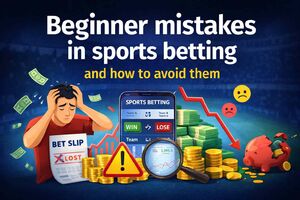
When a person first starts their journey in sports betting, it seems quite simple: pick the obvious favourite, place a bet, and wait for a win. But after a few weeks, most beginners face a series of losses and begin to think they are simply unlucky (remember what happened this weekend with Manchester City, Chelsea, Liverpool, and Bayern)

Serge Gorelikov
If you take a close look at the betting lines of most European bookmakers, you can notice an interesting feature: the line appears huge, but in reality, it is quite limited. Yes, at first glance, there are thousands of events: football, tennis, basketball, ice hockey, etc.

Klimentijs Konevs
March launches a new betting cycle, demanding structure and discipline from the start. The beginning of the month is ideal for reassessing your strategy, evaluating your bankroll, and defining priority tournaments. While March’s sports calendar is packed, tennis and football remain the primary areas for analysis.

Serge Gorelikov
The second legs of the UEFA Champions League knockout phase play-offs are not just a continuation of the tie. They are a concentration of information. The first matches have already given us a clear signal: what condition the teams are in, who is decisive in key moments, who is struggling physically, and who only switches on when the Champions League anthem plays.

Serge Gorelikov
In the world of betting, there is a concept that frightens both beginners and professionals alike - tilt. This is a state in which a player loses self-control, starts acting impulsively, and abandons their own strategy. Tilt is not just a bad mood after a loss. It is a psychological breakdown in which emotions temporarily override reason, and decisions stop being rational.

Serge Gorelikov
In the world of sports betting, people usually talk about strategies, odds, discipline, and bankroll management. But there’s another element, just as important in any system - feedback. Without it, it’s impossible to know whether what you’re doing works or if you’re moving in the right direction. That’s why today I want to talk not about bets, but about how people respond to them.

Serge Gorelikov
A predictive model in betting is a formalised way of estimating the probability of an event outcome based on data rather than intuition. Unlike one-off predictions, a model aims to be reproducible, scalable, and resistant to the bettor’s emotions. Understanding how such models are constructed is a key step in moving from casual betting to a systematic, structured approach.