
Home Bookmakers Tips Bonuses

Brainfight Bet

Feedback as a tool for author's progress

In the world of sports betting, people usually talk about strategies, odds, discipline, and bankroll management. But there’s another element, just as important in any system - feedback. Without it, it’s impossible to know whether what you’re doing works or if you’re moving in the right direction. That’s why today I want to talk not about bets, but about how people respond to them.

Model-based approaches: How predictive models for sports betting are built

A predictive model in betting is a formalised way of estimating the probability of an event outcome based on data rather than intuition. Unlike one-off predictions, a model aims to be reproducible, scalable, and resistant to the bettor’s emotions. Understanding how such models are constructed is a key step in moving from casual betting to a systematic, structured approach.

How to stay rational during winning and losing streaks

Rationality is the ability to make decisions based on logic, data, and a long-term strategy rather than the emotions of the moment. However, winning and losing streaks are precisely what most often undermine rational thinking. People either begin to overestimate their abilities or, on the contrary, lose confidence and act impulsively. Understanding these mechanisms is the key to stability in any activity involving risk and uncertainty.

The trap of one's own opinion in sports betting

In betting, most mistakes are made not because of a lack of information, but rather due to a distorted perception of it. One of the most dangerous cognitive biases is confirmation bias. It lies in a person's tendency to seek out, interpret, and remember information in a way that confirms an already formed opinion, while ignoring or devaluing opposing facts. In betting, this trap is especially destructive because every decision is directly tied to money.

Summing up my results for three months

Over these three months, we've covered a path that takes years for many bettors. This wasn't a series of random bets or a chase for quick money. It was systematic work. More than 50 bets, an average odds of 2.00+, constant analysis, mistakes, adjustments, and conclusions. And most importantly, an understanding that it's not luck or one-off winning streaks that matter, but mathematics, discipline, and bankroll management.

My Christmas gift: Seven types of value bets

Today I'm giving you 7 betting setups. Your experience doesn't matter, because I'll explain the logic and show the examples. The main thing is to understand what to do, when to do it, and why it works. I expect that you're a mentally mature person and understand this:

Live betting lines: How and why do the lines move?

Live betting is a fast-paced environment where odds update every second under the influence of numerous factors. Unlike pre-match markets, which are relatively stable, live odds reflect the current state of the event, the bookmaker's reaction, and the collective behaviour of all bettors. To work profitably in live betting, you must understand how this system operates and why odds shift the way they do.

How to distinguish noise from signal in sports data

Data analysis has become the foundation of an accurate prediction in modern sports betting. But the paradox is that the data itself can both help and mislead you. The key task is learning to understand the difference between "noise" and "signal". A signal is information that reflects reality and genuinely improves prediction results. Noise, on the contrary, is a random fluctuation without predictive value. The ability to separate one from another is the basis of a professional approach.

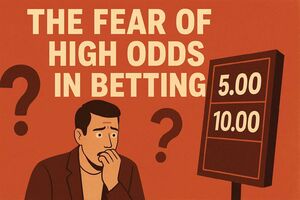
The fear of high odds in sports betting

One of the most common psychological barriers among sports bettors is the fear of high odds. This fear shows up as a reluctance to place bets on events with odds of 3.00, 5.00, or higher, even when such bets objectively hold value. The reason lies not in mathematics, but in the psychology of risk and probability perception.

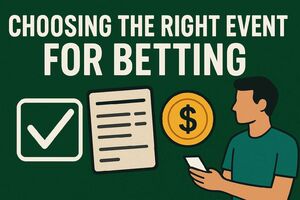
Choosing the right event for betting

Choosing the right event is a fundamental stage in betting that directly determines the long-term success of any player. It's a mistake to think that your profit depends on analysing a specific match only. True skill lies in the ability to select events correctly from the vast number of available options.

The psychology of bankroll management

Bankroll management is one of the key factors for success in sports betting, and its foundation lies not only in mathematics, but in the psychology of the player as well. Many bettors lose money not because they make wrong predictions, but because they cannot control their emotions and manage their betting capital. Understanding the psychological aspects of bankroll control helps maintain discipline and long-term stability. Betting is business, and your behavior at work or in business should be reflected in your betting approach.

The Kelly Criterion in betting: How to maximise profit and minimise risk

The Kelly Criterion is one of the most famous bankroll management strategies used in betting. Its goal is to determine the optimal percentage of your bankroll for a bet to maximise long-term capital growth while avoiding bankruptcy. Unlike flat betting, the Kelly Criterion considers both the probability of an outcome and the bookmaker's odds. It's based on mathematics and probability theory, making it one of the most rational systems.

Managing your bankroll the right way

One of the key components of success in sports betting, just like the ability to analyse events, is proper bankroll management. Even the most accurate predictions won't guarantee a stable income if you can't control your finances. The bankroll is the amount of money a player allocates exclusively for betting, without touching personal or family funds. And, obviously, under no circumstances should you take out a loan.

Looking for value odds

Continuing from the previous topic, let's talk about the concept of "value odds". To understand the idea, we need to see how the odds are formed and what they actually reflect.

How bookmakers make their money: Margins, odds, and betting lines

Greetings, ladies and gentlemen! I've noticed an interesting thing: most people in the betting world don't know - or, what's even worse, don't understand - the most important thing: how bookmakers make money. Why is it vital to know and understand this? The answer is simple: we and the bookmaker are on opposite sides of the pitch. And the goose that lays the golden eggs is right in between us. Either we make a profit, or the bookmaker does - there will be no draw. That's why we must study our opponent thoroughly.