


Super 6 round 40 predictions and tips
By Klimentijs Konevs | Updated: December 16, 2025
The 2026 FIFA World Cup draw has now taken place, with teams learning their group stage opponents on Friday, December 5, at the Kennedy Center in Washington, DC. It was the first draw held under FIFA's new system, with the major changes introduced for the tournament.
The World Cup has been expanded to 48 teams, creating 12 groups and a new knockout pathway. That means more groups, more matches and new rules. With hosts Canada, Mexico and the USA already locked into Pot 1, the draw officially set the group stage and revealed the routes for each team to navigate.
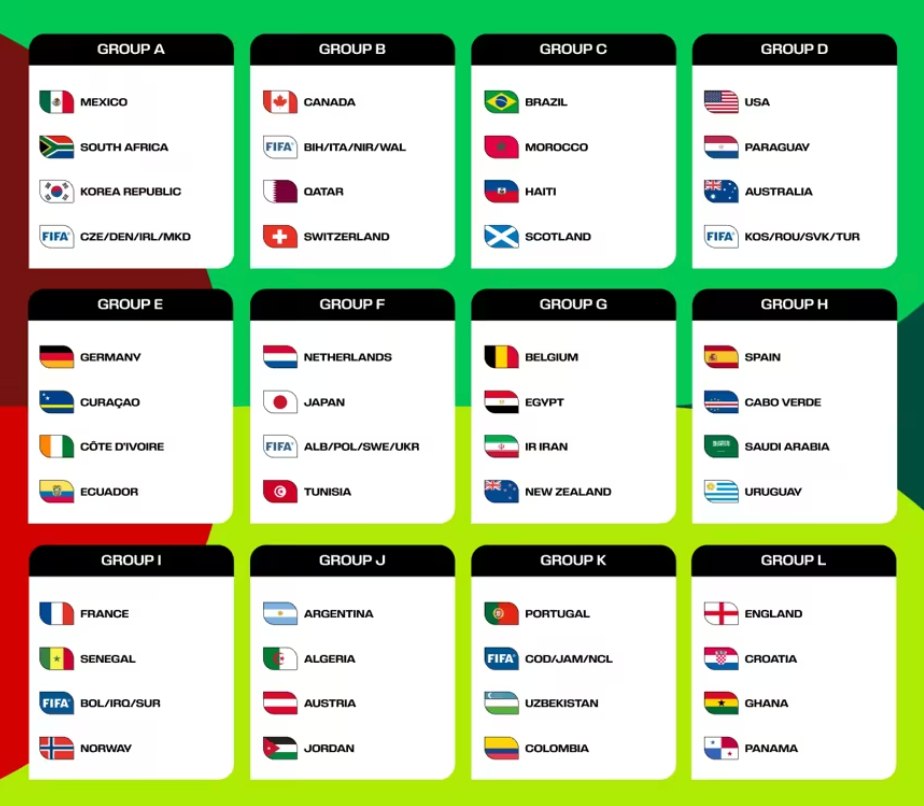
The tournament expansion has opened the door for more countries across every confederation, giving the competition a much broader and more diverse lineup. At the moment, 42 nations have already qualified, while the final spots will be claimed through European and intercontinental playoffs. It's the most open World Cup we've ever seen, offering more teams a genuine shot at making history.
Canada:
Mexico:
USA:
| Group A | Group B | Group C | Group D |
| 🇲🇽 Mexico | 🇨🇦 Canada | 🇧🇷 Brazil | 🇺🇸 USA |
| 🇿🇦 South Africa | ITA/NRL/WAL/BIH | 🇲🇦 Morocco | 🇵🇾 Paraguay |
| 🇰🇷 South Korea | 🇶🇦 Qatar | 🇭🇹 Haiti | 🇦🇺 Australia |
| 🇪🇺 CZE/DEN/IRL/MKD | 🇨🇭 Switzerland | 🏴 Scotland | 🇪🇺 TUR/ROU/SVK/KOS |
| Group E | Group F | Group G | Group H |
| 🇩🇪 Germany | 🇳🇱 Netherlands | 🇧🇪 Belgium | 🇪🇸 Spain |
| 🇨🇼 Curacao | 🇯🇵 Japan | 🇪🇬 Egypt | 🇨🇻 Cabo Verde |
| 🇨🇮 Côte d'Ivoire | 🇪🇺 UKR/SWE/POL/ALB | 🇮🇷 Iran | 🇸🇦 Saudi Arabia |
| 🇪🇨 Ecuador | 🇹🇳 Tunisia | 🇳🇿 New Zealand | 🇺🇾 Uruguay |
| Group I | Group J | Group K | Group L |
| 🇫🇷 France | 🇦🇷 Argentina | 🇵🇹 Portugal | 🏴 England |
| 🇸🇳 Senegal | 🇩🇿 Algeria | 🌏 NCL/JAM/COD | 🇭🇷 Croatia |
| 🌏 BOL/SUR/IRQ | 🇦🇹 Austria | 🇺🇿 Uzbekistan | 🇬🇭 Ghana |
| 🇳🇴 Norway | 🇯🇴 Jordan | 🇨🇴 Colombia | 🇵🇦 Panama |
After the group stage, the top two teams from each of the 12 groups will qualify automatically, giving us 24 nations in the next round. They will be joined by the eight best third-placed teams, creating a Round of 32 for the first time in World Cup history. From that point, the tournament follows a familiar elimination route: Round of 16, quarterfinals, semifinals and the final.
There is one important new rule: the world's top four-ranked nations must be kept on separate knockout paths. Spain and Argentina will be placed on opposite sides of the bracket, and the same applies to France and England. If all four top their groups, they would only be able to meet in the semifinals or later.
The World Cup begins on 11 June, with Mexico facing South Africa in the opening match. Following the group stage, the expanded knockout phase begins with the Round of 32 in late June.
The Round of 16 starts on 4 July, with two matches played each day until 7 July.
The quarterfinals follow shortly after, beginning on 9 July, with one match on both 9 and 10 July, and two quarterfinals played on 11 July.
Two semifinal games will be staged on 14 and 15 July, before the tournament concludes with the final at MetLife Stadium in New York New Jersey on 19 July.
For the 2026 World Cup, FIFA has refreshed the seeding system to fit the expanded format. All qualified nations, along with the play-off placeholders, are spread across four pots based on the FIFA/Coca-Cola Men's World Ranking from 19 November 2025.
The pots are organised mainly by the FIFA world rankings, but a few key rules shape the final layout. Canada, Mexico and the USA are guaranteed places in Pot 1 regardless of where they sit in the rankings, joining the nine highest-ranked teams worldwide. After that, the next 12 teams in the rankings fall into Pot 2, followed by another 12 in Pot 3.
Pot 4 is a mix of the lowest-ranked qualified nations plus all six play-off placeholders, which come from both the FIFA inter-continental play-off tournament and the UEFA playoffs.
One of the geographic restrictions that applies during the draw is that teams from the same confederation cannot be placed in the same group. However, the exception is UEFA, which may have up to two teams in any group.
Relive the magic of the 2022 FIFA World Cup final! Argentina's epic 3-3 extra-time battle with France
A moment etched in football history!
— Kelvin🔱 (@_FCBKelvin) November 16, 2025
Before the draw begins, FIFA confirms the four pots based on the ranking order and special placement rules. Below is the full breakdown of all four pots for your reference:
| Pot 1 | Pot 2 | Pot 3 | Pot 4 |
| Canada | Croatia | Norway | Jordan |
| Mexico | Morocco | Panama | Cabo Verde |
| USA | Colombia | Egypt | Ghana |
| Spain | Uruguay | Algeria | Curacao |
| Argentina | Switzerland | Scotland | Haiti |
| France | Japan | Paraguay | New Zealand |
| England | Senegal | Tunisia | UEFA Play-Off A |
| Brazil | Iran | Ivory Coast | UEFA Play-Off B |
| Portugal | South Korea | Uzbekistan | UEFA Play-Off C |
| Netherlands | Ecuador | Qatar | UEFA Play-Off D |
| Belgium | Austria | Saudi Arabia | FIFA Intercontinental Play-Off 1 |
| Germany | Australia | South Africa | FIFA Intercontinental Play-Off 2 |
The draw will determine how all 48 teams are divided into groups. It follows a strict process to protect competitive balance and ensure the top-ranked nations are spread evenly through the knockout pathways.
The World Cup will feature 12 groups, each containing four teams. Every team plays three matches, with the top two from each group advancing automatically. They will be joined by the eight best third-placed teams, forming a new Round of 32.
FIFA applies region-based rules to prevent groups from becoming overcrowded with teams from the same part of the world. No group can contain more than one team from any confederation, except UEFA, which has 16 qualified sides. European nations must appear in every group, but no more than two can be placed together.
The draw opens with Pot 1, beginning with the three hosts. Mexico automatically goes into A1, Canada into B1 and the USA into D1, each selected using colour-coded balls. The rest of Pot 1 is then drawn into the remaining Groups C to L, always taking position 1. After that, the draw moves through Pots 2, 3 and 4 in order. These pots follow a preset pattern that decides where each team lands within its group, helping keep the overall schedule balanced.
🇦🇷 🌟 Argentina remain the only national team to win THREE World Cup trophies in the last 50 years-1978,1986 and 2022.
🇩🇪 2 - Germany: 1990 and 2014
— FIFA World Cup Stats (@alimo_philip) October 14, 2024
🇧🇷 2 - Brazil: 1994 and 2002
🇫🇷 2 - France: 1998 and 2018
🇮🇹 2 - Italy: 1982 and 2006
🇪🇸 1 - Spain: 2010… pic.twitter.com/QUv77T2JMN
The leading nations sit in Pot 1. Spain, Argentina, France and England top the FIFA rankings and enter as the strongest contenders. Spain head into the draw as early frontrunners at 5.50, while England at 7.00 and France at 8.00 sit just behind them. The teams cannot meet before the semifinals if they all win their groups.
We post daily betting tips on major sports in our Telegram channel. Join us to stay informed and never miss our latest predictions!

Share:


More news
Super 6 round 40 predictions and tips

Holloway vs Oliveira 2: Prediction and Odds for UFC 326 fight
2026 World Baseball Classic predictions and betting odds
Scotland vs France prediction on the Six Nations match on March 7th

UFC 326 Holloway vs Oliveira 2: Predictions and betting tips

2026 F1 Championship predictions and betting odds
